AD (728x90)

Showing posts with label Technology. Show all posts

Tuesday, 24 June 2014

Mobile Ad Startup TapSense Announces Support For Wearable Apps, Starting On Pebble

If you’re building apps for the Pebble smartwatch and other wearable gadgets, startupTapSense hopes to bring you into the wonderful world of mobile advertising.
The company announced today that its mobile ad exchange will support wearable apps, beginning with those in the Pebble appstore. You can see a video demo of an ad below.
However, as you watch the demo (as opposed to the mock-up above), you might notice a lack of actual smartwatches. That’s because TapSense isn’t running ads on the Pebble itself. Instead, it’s helping developers target ads at iOS and Android users who own Pebble devices. The company says those ads will link directly to the promoted apps in the Pebble appstore.

In other words, developers will be able to promote their apps through the same sorts of ads used by other mobile developers. TapSense founder and CEO Ash Kumar added that Pebble’s store (where users find apps on their phones, and those apps are then synced with their smartwatches) exemplifies a model where the smartphone becomes the hub for your other wearable devices.
Having that hub is important, he suggested, because “the wearables market will remain fragmented for some time,” without any one device dominating.
To a certain extent, this may be a bit of experiment, allowing TapSense to explore wearables and giving them a leg up when and off the market really takes off. Looking ahead, Kumar said he plans to support other wearable apps in the same way. He started with Pebble because of its reach and the diversity of apps (more than 3,000).
Kumar also said that, as far as he knows, TapSense is the first mobile ad company to build this kind of Pebble support. (I emailed Pebble for confirmation but haven’t heard back.)
And yes, eventually he’d like to run ads within those wearable apps, too, particularly as they provide an opportunity to deliver real-time, relevant advertising that’s much better than “annoying banner ads.”

Sunday, 22 June 2014

Turn Your Wireless Mouse Into a Power Glove

The upcoming weekend is a perfect time to tackle a new DIY project, so why not focus that DIY power on a new computer accessory? Today’s step-by-step instructional video shows you how to take a wireless mouse and turn it into an awesome power glove gaming accessory!.This Looks To Awesome and Geeky.I would suggest this because requires very less capital and is easy to build so watch the First Video in Our DIY Section.You can Use this Mouse especially for gaming purposes.Get Started


Wednesday, 18 June 2014

T-Mobile Offers Free Week-Long iPhone 'Test Drives'

T-Mobile is launching a new program that will allow prospective customers to try out their network, with a new iPhone 5S, for a week — completely free of charge.
The program, which the carrier is calling Test Drive, is the result of a partnership with Apple. It's meant to give prospective customers a risk-free way to try out a new device with a new carrier, without leaving their existing contract.
People will be able to sign up for the service beginning Monday. Those who sign up will receive an iPhone 5S, equipped with an unlimited plan, to use free of charge for seven days.
The phone must be ordered online through T-Mobile's website and customers will be required to provide a credit or debit card number, along with a matching billing and shipping address, to receive the phone. A temporary hold will be placed on the user's credit or debit card for the amount of $699.99 during the test period, but customers won't be charged unless they fail to return the device at the end of the week.
Should they decide to switch carriers at the end of that time, T-Mobile will pay the termination fees on their existing contract.
“While the carriers ask you to buy blind, the Un-carrier gives you transparency," John Legere, T-Mobile's CEO, said in a statement. "Our network kicks ass, and now people can experience for themselves what a data-strong network can do with T-Mobile Test Drive.”
The network is also expanding its LTE reach to 16 new markets across the U.S, including Atlanta, Dallas, Orlando and Los Angeles.

After Catching Google’s Eye, Mantis Vision Bags $12.5M From Qualcomm, Samsung And Others For Its Mobile 3D

Mantis Vision, a company whose mobile 3D technology is being used by Google for its 3D-sensing Project Tango smartphone, has just announced it’s raised a $12.5 million strategic funding round from a range of mobile focused investors including Qualcomm, through its venture investment group, Qualcomm Ventures; and Samsung.
Flextronics’ hardware venture arm, Lab IX, also invested in the round, along with Chinese optical manufacturing firm Sunny Optical Technology.
Mantis’ core 3D capture platform tech is called MV4D. It offers “motion-capable” 3D range-imaging technology, meaning it can handle the capture of moving as well as static 3D objects.
The engine uses a light pattern projection system coupled with depth sensors and proprietary light processing algorithms to create a depth map of the captured scene — so that a handheld camera with Mantis components can record 3D data.
The company also makes post-processing software that allows users to edit and view captured 3D data on their mobile devices.
While 3D tech on smartphones is not currently the norm — beyond a brief fad for 3D screens a few years back — interest in mobile 3D is building again. For instance, ecommerce behemoth Amazon is expected to introduce a handset later today that will include some 3D smarts, thanks to four infrared cameras which track the head of the user to deliver stereoscopic effects from a 2D LCD pane.
And, as noted above, Google is also interested in 3D capture on mobile with Project Tango. As, presumably, is Samsung, given its investment here. Apple, meanwhile, acquired another Israeli 3D sensor company, PrimeSense, last November. So the big names in mobile making are lining up to put dollars into 3D sensing tech.
Mantis, which was founded back in 2005, said the new funding round is its first institutional raise, although it has apparently pulled in more than $25 million in private money since being founded.
It said the new funding will be used to reorganize the company to focus on licensing its core technology and for further development of its software platform and products.
Its initial focus was on building handheld 3D scanners. It’s now shifting to handheld mobile devices — having successfully figured out how to miniaturize the necessary components — applying the software expertise it built up in the scanner space to mobile devices, said Mantis CEO Amihai Loven.
“The core technology is a single frame structured light active triangulation system. Somewhat similar to PrimeSense,” Loven told TechCrunch. “The advancement is the level of code, which will result with the level of signal and quality of 3D data that we can capture. So our focus is day one was high accuracy, high resolution, content creation, as opposed to 3D sensing [and] gesture recognition.”
“The goal is to… further penetrate into the mobile [market] by licensing the core technology to OEMs to enable them to get access to hardware components and designs with their supply chain, and to push the software development both at the core level — let’s call it the 3D engine that makes the input of the camera become 3D data — but also an application platform, which is not an application by itself, which is more like an SDK for developers, which allows constant editing, altering and manipulation for sampled 3D data,” he added.
Loven said the mobile market will see many 3D implementations in the next year, but would not comment on specific companies it’s working with or not (beyond the Google partnership which is in the public domain).
Instead, he said  there will be a “clear differentiation” between products that have what he called “partial 3D experience and full 3D experiences”.
“We are aiming for devices that allow content creation, content sharing, content manipulation, and there will be probably many products out there and once we go out it will be clear which ones we enable and which no, but I cannot comment at this stage,” said Loven.
In terms of what 3D capture offers the smartphone end user, he argued it will bring more immersive, less passive content experiences than are currently offered by 2D photo and video capture.
“In the next, let’s say two years… people [will] capture people and moments and access the data in a completely different way  so they are immersed in the environment, and not just observing it so that it’s a flat representation of something that happened,” he added.
Commenting on the funding in a statement,  Mony Hassid, senior director at Qualcomm Ventures, said: “Qualcomm’s investment in Mantis Vision will enable both companies to accelerate the development and adoption of new 3D technologies for mobile devices and services as well as the applications running on top of them.”
“We believe that mobile 3D capture will become an increasingly important, if not primary, means of communication. The Mantis Vision team has proven its ability to create 3D technology and products that deliver,” added Lior Susan, vice president and head of Lab IX, in another statement.
“We are excited about the traction and virality that the MV4D platform can generate in a very short time, and we want to provide the funding and support for this team to extend its leadership in this new and emerging sector.”

Tuesday, 17 June 2014

Slingshot or Snapchat ?

After its accidental rollout and subsequent removal from the App Store last week, Facebook's latest standalone app, Slingshot, has officially launched.
The app, the company's latest (and likely last) effort to create a true Snapchat competitor, allows users to send disappearing photo and video messages. But Facebook isn't framing Slingshot as a messaging app; rather, those who have been working on the app say it's more a way of sharing what you're up to at any given moment — a visual status update, if you will.
But while Facebook has clearly tried to differentiate Slingshot's ephemeral messages from Snapchat's, the app manages to both feel both more polished and more desperate. Here's a look at how the two disappearing messengers compare.

Getting started: finding your friends

Unlike Facebook's other standalone apps, Slingshot does not solely rely on your Facebook friends list for contacts. Like Snapchat, accounts are tied to your phone number, which you must verify before you can start using the app. Once you have verified your account, you can search for friends from your contacts list, Facebook or look up individuals by user name.
However, even though Slingshot allows you to search for people you know, there isn't one central contacts menu where you can easily view all your connections.The only time you can see all of your contacts at once is after shooting a photo or video.
And, unlike Snapchat, there is no approval process for adding connections. Anyone can send messages to anyone whose information they have. Facebook says an approval process isn't necessary because users can simply choose to ignore the message they don't want to see. You can also elect to ignore all messages from individual users by hiding them (you can always unhide people in the app's settings).
Launching Slingshot immediately takes you to the app's camera. The selfie button toggles between the device's front and rear-facing cameras, and holding down the shutter button allows you to record a video. Although Slingshot's overall camera quality seems to be better than Snapchat's, the app doesn't allow you to zoom.
As with Snapchat, you can add drawings and text to the photos and videos you send. But with Slingshot, both features feel far more elegant and give you much more control.
Text is limited to 140 characters, but can be repositioned on the image. Unlike Snapchat's text, which always remains the same size, Slingshot's text will get bigger when you drag it down from the top of the screen.
The drawing tool is also far more advanced than Snapchat's — you can adjust both the color and the size of the brush. Dragging along the color bar selects a color, dragging left or right changes the brush size, moving the tool right makes the brush smaller and moving it left makes it larger.

'Shot for shot' messages

Should you receive a new message, you'll see a notification telling you how many locked messages are waiting. If you swipe down, you can see who the message is from, along with a small pixelated thumbnail of the image that gives you a hint of what the photo is without actually revealing anything.
Each new message arrives with the sender's name displayed at the top. Messages sent only to one recipient will say "just for you" along with the sender's name, while those sent to multiple recipients will only show the sender's name.
One noteworthy aspect of the app is that it won't let you see new messages until you send one of your own back to the sender. Facebook says the reason behind this is to take the pressure off users to constantly read and send messages. But, in reality, the feature has the opposite effect — by forcing people to send responses to messages they haven't yet seen, Facebook is essentially holding your messages hostage in the hopes of increasing engagement.
The app's React option is the one exception to the 'shot-for-shot' rule. You can respond to any message with a reaction by tapping on the image, which brings the camera into the lower half of the screen. Using this option means the recipient will not be forced to send their own message in order to view a reaction.

So which is better?

In general, Slingshot isn't singularly focused on making things disappear. You can enable automatic saving of the photos you take in the app's settings and there are other small touches aimed at helping you preserve your photos — if you take a photo and close the app without sending it, for example, the photo will be there waiting for you the next time you launch the app.
And unlike Snapchat, there is no time limit on Slingshot's ephemeral messages, once you've managed to unlock them. The photos will remain onscreen as long as you like, but will disappear forever the moment you navigate away from the screen. And, if you take a screenshot in Slingshot, the sender will not be notified.
Even though Snapchat made strides toward improving its design in its most recent update, Slingshot's overall design feels much more polished and elegant than Snapchat's. While Snapchat can be slow and often stutters while loading and sending messages, Slingshot is fast and responsive.
The six months of development Facebook put into the app really shows, but maybe that's the problem. One of the reasons Snapchat has been so successful is because the app focused more on sharing and less on bells and whistles.
In the end, although Facebook isn't presenting Slingshot as a messaging app, by forcing its users to send replies to messages they haven't even sent yet, the app just feels like a gimmick designed to force user engagement.

Sunday, 15 June 2014

Want To Make Your Windows Look Like Mac?

Windows is the most popular OS currently on the desktop and laptop platforms,But Everyone also wants to try out what that cool in Mac!.Windows is more customizable  and you can tweak many thing onto it.So we thought of the idea about making your windows look like Mac which includes all icons start-button,Windows,Desktop,Animations and Sounds.So if you're crazy about installing mac try out this very easy and simple way to Make your Windows Look Like Mac.In this tutorial I'll be using a new tool called CustoPacks which allows you to tweak your OS just by a few click and plus you can create your own theme pack.


Step 1 . Download and install CustoPacks Tools :

First you need to download the CustoPack Tools from their website it is about 30 MB and will download in 10 minutes if your internet is really fast.Follow the link below


Step 2 . Tweaking MacOS


Once you're done Installing CustoPacks which is pretty easy so I'm not showing the images now you need to download the MacOS X Lion themes
Click Here to Download Mack OS X Lion Theme


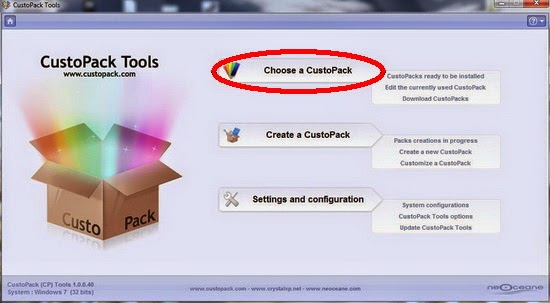
Now Run The CustoPacks application and Click Choose CustoPack Look Below


 Now You will be taken to and Customization Page Choose the Settings as below Pic


And That's It Restart your PC to Apply the changes and enjoy your MacOS them Here are the Screen Shots Of the Final Tweak


Friday, 13 June 2014

Need To Save Private Photos? Check Out Focus

We've all dealt with it before: you hand someone your phone to show them a photo, and the jackass swipes forward and/or backward to look at your other photos. That's a huge no-no, but unfortunately there are still people out there who didn't get the memo (or are just too damn rude to care). Fortunately, there's a way to keep this scenario from happening ever again.
It's a simple app called Focus, and it basically puts other photos under a PIN code, so when someone tries to swipe left or right, they're greeted with this message:

There are two versions of Focus: an ad-supported, free variant; and a paid version that costs a dollar. If you never want to experience this again:

BMW Controls GoPro Camera


As a result of a new partnership between GoPro and BMW, it’s never been easier to record your hoonage antics. Select late-model BMW cars will soon be able to control GoPro cameras directly from the dash. Just click record on the dash of the car and the connected GoPro cameras click to life.
Starting in July, the owner of a 2012 or later properly equipped BMW or Mini will be able to control Wi-Fi-enabled GoPro cameras. The GoPro app has to be installed on an iPhone connected to the BMW. Once connected, the driver can select the GoPro app through the BMW ConnectedDrive or Mini Connected menu. From there, the driver can view the camera’s field of view and control recording. The camera streams near-live video to the dash while the vehicle is stationary. But once the tires spin, the preview clicks off.
This integration addresses the cumbersome, on-camera controls of GoPro cameras. Almost all of my GoPro videos start with a few seconds of my head as I fumble with the controls. Previously, GoPro introduced the Wi-Fi-enabled GoPro Hero 3+ camera that allows owners to use smartphone apps to preview camera placement and initiate recording. BMW takes that thought one step farther.
This sort of integration is the next step for gadget makers. Car companies are increasingly looking for ways to differentiate themselves from the rest and embracing consumer brands, like GoPro, Apple and Google, is a keen way to gain an edge.

Sunday, 8 June 2014

New iOS 8

Apple’s various additions to iOS 8 mean we’re going to see a big shift come September, in terms of what’s available to both consumers and developers, but the group that should be most excited might be marketers and others trying to get users buying things on and with their devices. A few of the new features in iOS 8 make it much easier to shop on and with your iPhone, and since Apple already has a mobile user base that’s shown its willingness to spend, that’s very big news.
One such feature was uncovered through the beta late last week: with iOS 8, the iPhone’s camera can snap pics of credit cards to automatically populate credit card information fields in Safari. That means no more arduous copying out of your card number, cardholder name and expiration date every time you want to complete a transaction online – instead it’s a single-click thanks to optical character recognition, and it works automatically with existing web forms, so there’s no work required on the part of web devs.
That’s only one of the new features that could lead to increased ecommerce activity on iOS 8-powered devices; previously, we saw how iOS 8 can use indoor positioning systems to direct shoppers within a large retail environment. And Continuity can play a big role in helping purchases take place online, too – Handoff lets a user move from doing something on their phone to completing it on the desktop, and vice versa, and that includes a browsing session. You can easily imagine how that might work with shopping online, as a user browses on their device and then moves to the web to do more in-depth research, or shifts back to the iPhone to take advantage of credit card scanning to complete the check-out.
Apple has a lot more going on in iOS 8 besides these changes, but they make it just that much easier for those trying to use mobile devices to encourage sales and commerce activity. It’s still unclear what, if any kind of mobile commerce push Apple will make itself – we’ve heard rumors about iTunes becoming a platform for much broader types of payments for a while now – but in the meantime, it’s clear it still wants to be the best mobile platform for those looking to drive pay-based engagement.

Razor Blade : Best Gaming Laptop


Mark 2014 as a year to remember on your calendar, your Facebook page, your brand new Twitter profile page that you still haven’t quite figured out. Because you won’t remember what made this year great until someone on Reddit writes about it ten or twenty years from now and you think to yourself, “Oh yeah, that’s when laptops became awesome.” Finally.

In my nearly eight years of writing about technology and 20+ revolutions around our little sun playing with tech, this is the first time when mobile computing hasn’t sucked. In fact, it’s a joy! And the new Razer Blade is the epitome of excellence in mobile computing: kickass desktop-level performance, over six hours of battery life, a gorgeous display, all in a thin clamshell design that's lick-worthy. Come and get it.

Refinement, minus the screen

If you think the Blade looks a lot like the MacBook Pro Retina, you're right. Last year's model was a success, and aside from some fine tuning, almost nothing has changed. The keyboard is tighter with excellent low-profile keys; the trackpad is smooth and for some reason still includes two physical buttons and no multi-touch right click; and the speakers produce soft, high-quality audio for movies, music, and of course, games.
4K (3,840 x 2,160) content may be all the rage nowadays, but unless you're watching House of Cards, there's no content. 3K? It doesn't even exist, and it never will. 1080p video content doesn't fit right, and neither does 4K. The only exception is games, which can almost always fit to the screen's native resolution. Windows doesn't even look good on it; everything's too small.The big update is a vastly improved 3K monitor. This Blade has a 3,200 x 1,800 pixel resolution display, the highest I’ve ever seen on any monitor less than double the size. And that’s a problem.

Yet the display is so gorgeous, so well made, that almost anything looks spectacular on it. 720p video content is fuzzy, but 1080p video looks great, and if you set the screen for other high resolutions like 2,048 x 1,152, the video quality is still excellent. This is one of the best laptop monitors I’ve ever tested, one that produces excellent color and light contrast, is bright enough for outdoor use even with a glossy display, and it’s a touchscreen to boot. It looks so good at other resolutions that even if you never use the native 3K, every other widescreen resolution looks great.

Performance? Let slip the dogs of war

For a 14-inch laptop, the Blade is the fastest, highest-performance machine I’ve ever tested of its size. It boasts some incredible specs: a quad-core 2.2GHz Intel Core i7 4702HQ, 8GB of RAM, and the all new NVIDIA GTX 870M with 3GB of video RAM. The Blade supports 802.11ac Wi-Fi, the fastest wireless technology, and the whole thing ships with 128/256/512GB of memory. The pre-production test unit Razer provided shipped with 128GB and retails for $2,200.
This machine was built for speed, and every part pushes the envelope. It doesn’t matter if you’re just browsing the web or playing Metro: Last Light in its native Russian, the Blade gets the job done fast. And it’ll last over six hours on the battery when word processing or web browsing. Gaming battery life isn't so hot, lasting just about an hour.
The Blade gets hot and while it’ll run many games extremely well when plugged in, it does throttle performance when on the battery. That means what’ll typically run at a steady 30 frames per second when plugged in will be unplayable on the battery, though with the right settings the Blade will run just about any of today’s top games and still look stunning.
Still, this laptop barely lasts over an hour for Batman: Origins and Crysis 3 while maintaining a solid 30 fps. Plug it in, and you’ll get noticeably better performance, and no longer fear losing another game save.

UltraHD gaming is the future... and it’s not ready for mobile

There’s only one place the Blade slips, and that’s at high resolution. Throw any game up at 3K and everything slows down. Adding more pixels on the screen is the most punishing task for the graphics processor, and it shows. The Blade can play every single game I threw at it at 1,600 x 900 with every graphical option set to maximum. At 3K, everything must be cut in half, and even then performance is always noticeably worse.
So yes, 3K gaming is possible on the Blade, but it isn’t worth it. That’s not to say that ultra-high-definition gaming isn’t better, because it absolutely is. Photorealistic games like Assassin’s Creed IV: Black Flag look ridiculously good at higher resolutions, but not if you have to turn off all of the settings that make it look so damn pretty.
As powerful as the Blade is, it cannot handle 4K/UltraHD gaming. Not in the way anyone would want to play, and certainly not in a reasonable way for a laptop. And if you thought 3K performance had limitations, 4K is just even harder to stomach. I tested the Blade with the Samsung U28D590D Ultra-HD 4K monitor and every single game ran better than on MSI’s GS60 Ghost, but not enough to warrant using those extra pixels.

Blade running

The Razer Blade isn’t a desktop replacement — it’s a mobile desktop. If I owned one, I’d replace my desktop for it because it’s so damn powerful, and it just so happens to fit very comfortably in practically any bag. Every other computer you can own is secondary. The Blade is a refined, beautiful laptop that is an absolute joy to use for everything from typing this review to hours of gaming.
As great as the Blade is, it’s a bit too ambitious. The 3K display produces excellent picture quality and is very bright, but it’s more than the laptop can handle. And all that power comes at a high price. $2,200 is expensive, and that’s for just 128GB of memory, barely enough for a few games. It’s not worthwhile without at least 256GB, which costs $2,400; 512GB sells for $2,700. The Blade is a machine that’ll be powerful for years, but that’s still a heavy cost.
When it comes to laptops however, nothing else compares. The Blade is the thinnest, lightest gaming laptop on the market. It’s sleek and badass and you’ll love every second of it. There are more powerful laptops out there, and I would get the Blade over all of them every time.
The Blade is a refined, beautiful laptop that is an absolute joy to use for everything from typing this review to hours of gaming.As great as the Blade is, it’s a bit too ambitious. The 3K display produces excellent picture quality and is very bright, but it’s more than the laptop can handle. And all that power comes at a high price. $2,200 is expensive, and that’s for just 128GB of memory, barely enough for a few games. It’s not worthwhile without at least 256GB, which costs $2,400; 512GB sells for $2,700. The Blade is a machine that’ll be powerful for years, but that’s still a heavy When it comes to laptops however, nothing else compares. The Blade is the thinnest, lightest gaming laptop on the market. It’s sleek and badass and you’ll love every second of it. There are more powerful laptops out there, and I would get the Blade over all of them every time.

Saturday, 7 June 2014

I-Cloud Apple


At its WWDC keynote earlier this week, Apple announced CloudKit, a new, “effectively free” developer framework that lets app creators tap into Apple’s iCloud so that they can more easily work cloud components into their mobile apps.
As Quartz’s Dan Frommer pointed out this morning, it was one of several signs during the keynote that Apple finally “gets” the cloud.
But it’s also a sign that Apple is taking the concerns of iOS and Mac developers more seriously than ever. Just last year, Matt Panzarino wrote that there were really two iClouds: the massive, mostly reliable infrastructure that Apple builds its apps on top of, and the hodgepodge of networking and syncing protocols that developers were handed with the first iterations of iCloud.
Because it wasn’t using the same underlying technology, Apple didn’t run into the same issues in features like Core Data syncing as your average iOS application developer, and thus didn’t take their problems as seriously. As Panzarino wrote:
One thing that could help is if Apple dogfooded more of iCloud’s developer API features in its own apps. Dogfooding, the process of a company using its own creations internally, is a well-respected method of ensuring maturity and stability, especially in complex services like iCloud. Apple currently only uses Core Data syncing in its iTunes Trailers app, which serves a lot of video but isn’t exactly the most complicated application. Because Apple doesn’t use these features of the API as much, it doesn’t run across the problems that are being run up against by developers.
The result was that many developers simply gave up on iCloud for their own apps and instead began to roll their own cloud syncing functions or integrating competing services from Amazon, Dropbox, or Google.
It seems that Apple’s hoping to change that. As Andreessen Horowitz analyst Benedict Evans wrote on Wednesday, the company showed off a bunch of impressive cloud-based functions in iOS 8 — and they’re built on the same CloudKit frameworks that anyone who downloads Apple’s tools has access to:
Hence one could suggest that Apple loves the cloud, just not the web (or, not URLs). This is obviously a contrast with Google, which has pretty much the opposite approach. For Google, devices are dumb glass and the intelligence is in the cloud, but for Apple the cloud is just dumb storage and the device is the place for intelligence. And it’s built a whole new set of APIs, CloudKit, to enable this for developers, which it is (for the first time, I believe) dogfooding, building the photos product on it.
The new photo editing tools in iOS 8 aren’t the only new features built on frameworks that anyone can use. The company also says that the new “Handoff” feature in Keynote, Safari, Mail, Maps, Contacts, Notes, and Reminders (which lets you seamlessly move between apps on your iPhone and your Mac to complete a task) is built on the same public APIs available to third-party developers.
Everyone benefits from Apple and third-party developers working on the same playing field. Apple will spend more time making sure that its frameworks for developers work in order to keep the quality of its own apps up to snuff, while developers won’t shy away from adding convenient cloud components that “just work” behind the scenes.

Friday, 6 June 2014

Amazon Enters Smartphone Market

Amazon is holding an event in Seattle in a couple of weeks, and everyone's invited. Really — anyone in the world can theoretically sign up, although the company says space is limited.
Democratizing a tech launch event — typically a very insider-y affair — is an uncommon, if gimmicky move, although it suggests that what Amazon has up its sleeve is pretty big. Whatever Amazon will unveil, teased in a comically vague video, will certainly be aimed squarely at a mainstream audience, and the most credible report so far says it'll be an Amazon-branded smartphone.
Rumors about an Amazon smartphone have circulated since the company unveiled its first Kindle Fire tablets back in 2011. For almost any hardware manufacturer, it makes sense to offer both a tablet and a phone — usually several.
After all, the technologies are virtually identical, so why only make one or the other when you could have a hand in both markets?

Why Amazon

But Amazon isn't a typical hardware manufacturer. The company doesn't make the Kindle Fire tablets because it excels at building devices — it makes them solely for the purpose of putting the company's digital services, such as Amazon Instant Video and the Kindle bookstore, front and center in a customer's tablet experience.
"With their tablet product, [Amazon] undercut the competition and did very well," says Tuong Nguyen, a research analyst at Gartner. "But I don't know what they can possibly offer me … that would be compelling enough that would make me want to have an Amazon phone."
For a company that's all about selling content, building a device that consumers want to use to consume that content (i.e. a tablet) is a logical move, and the strategy has worked pretty well so far. Apple's iPad is the clear leader in the tablet space, but Amazon's Kindle Fire devices have done very well by all accounts.
Smartphone owners use their devices differently from tablets, though, so the content-consumption logic doesn't translate so well to that device. Add to that a market that's already extremely crowded, and the headaches of dealing with wireless carriers and technologies, and
But there are two major market forces that could be factoring into Amazon's decision that now is a good time to enter the smartphone market. The first is that tablet sales have flatlined: People aren't buying them at the same clip as they used to, even though prices are at an all-time low.you can see why Amazon has ignored the smartphone space so far.

"If Amazon is trying to gain a bigger footprint, then tablets have limits," says Harry Wang, director of mobile product research at Parks Associates. "The next frontier is the shift to smartphones, because that's a bigger market."
Second is the rise of the phablet. Smartphones with big screens have been popular for a while, with the average size of a flagship Android phone now a little over 5 inches. Some are over 6, and there are rumors of even 7-inch phones on the way. With larger screens and ever-faster processing power, today's phablets are almost as good as tablets at "consumption."
If Amazon is feeling the squeeze on tablet sales, it would likely see the smartphone market next door — an order of magnitude larger — and decide it couldn't ignore that opportunity any longer. Building the hardware would be relatively easy, given its Kindle legacy.

What is different?

Of course, in today's smartphone market, hardware's the easy part. What's hard is differentiation — giving customers a reason to pick your phone over competitors. Amazon's teaser video appeared to imply that some kind of visual feature (3D holograms, perhaps?) would make its new smartphone stand out.
Whatever the novelty is, it's almost definitely not what people will buy an Amazon phone for. Innovative hardware might generate headlines, but it doesn't sell phones, where people mainly care about design, user experience and app availability.
A hologram that moves with your head will get pretty old by the second day, and competitors would soon replicate the feature anyway. "We're not about hardware anymore," says Nguyen. "It's all about eyeballs."
Amazon has other ways to differentiate its smartphone, however. It could offer an new kind of app or service that's exclusive to owners. 
An Amazon phone could offer a custom-designed mobile shopping experience, which would be attractive to many users. Parks Associates says 39% of all smartphone owners use retail apps — and that they're used, on average, only slightly less than video apps such as Netflix and YouTube.
More likely, Amazon will launch its phone with a new pricing model. The company has always been aggressive in pricing its Kindle tablets, and it'll no doubt do the same with a theoretical smartphone.
What would really take things to the next level, however, would be if Amazon offered its smartphone with a free (or nearly free) data plan. The company already sells LTE versions of its Kindle Fire tablets with free limited data. What if it convinced just one carrier to extend that model to a phone?
Whatever the pricing model ends up being, you can bet Amazon Prime membership will factor in. Chances are high that any owner of Amazon hardware is also a Prime member (Kindle e-readers excepted). The service will likely come bundled with the smartphone in some way; perhaps Prime members will get discounts on wireless services.
"They already have about 22 million prime members," says Wang. To those members, he adds, "Amazon could offer a great value in a smartphone."
Will creative pricing be enough to convince people to buy Amazon's smartphone? If the hardware is good enough — and there's no reason to believe it won't be — there's a good chance. In any case, Amazon is feeling enough desperation and hubris (if those delivery drones are any indication) to make a go of it.
Amazon launching a smartphone would be unusual, risky and probably gimmicky, but there are ways it could work. And if Jeff Bezos has that market in his sights, a year from now it may be hard to imagine a world without a Kindle phone.

Monday, 2 June 2014

Acer's Latest Smartwatch


Acer is the latest company with its sights set on the growing wearables space. The company debuted its first-ever smartwatch, the Liquid Leap, at the Computex conference in Taiwan on Monday, but it won't hit markets until this summer.
The device is part fitness tracker and part smartwatch, with the promises of keeping you updated on daily activity; it monitors steps taken, distance, calories burned and sleep while performing smartwatch-like tasks, including sending and receiving emails and text messages.
The device, which is available in various colors including orange, pink, white and black, resembles a fitness tracker more than anything else. The slim band is strikingly similar to theFitbit with a touch of the Jawbone Up, but features brighter (and better) colors, plus a beautiful display. Although it's also made of rubber, similar to the competitors, its slim form factor looks more like jewelry than other models on the market.
The Liquid Leap will only work with Acer's Liquid Jade phone, which limits the amount of consumers who will be able to get their hands on the smartwatch. It's unclear whether Acer will open this up to other smartphones in the future.
Acer hasn't announced the price, but said it will cost less than €99 in Europe ($135), according to Engadget. Because the company hasn't revealed much in terms of details and specs, it's hard to say at this point how it will stack up against competitors.
As of now, Fitbit accounts for 50% of the 2.7 million wearable bands, including fitness trackers and smartwatches, that shipped worldwide in the first quarter of 2014.It's no surprise that Acer is interested in the wearable market, as consumer interest is only heating up. Earlier this year, research firm Canalys reported that smartwatch shipments are projected to reach 8 million in 2014. That number is estimated to grow to more than 23 million units by 2015 and more than 45 million by 2017.

While Nike is closing up hardware production for its Fuelband, its software will likely be baked into Apple's long-rumored iWatch device, which is expected to debut sometime in the near future.
As for smartwatches, the Pebble continues to dominate market share with 35% of sales, followed by the Sony SmartWatch (29%) and the Samsung Gear (23%).


© 2013 FlatMag. All rights resevered. Designed by Templateism